
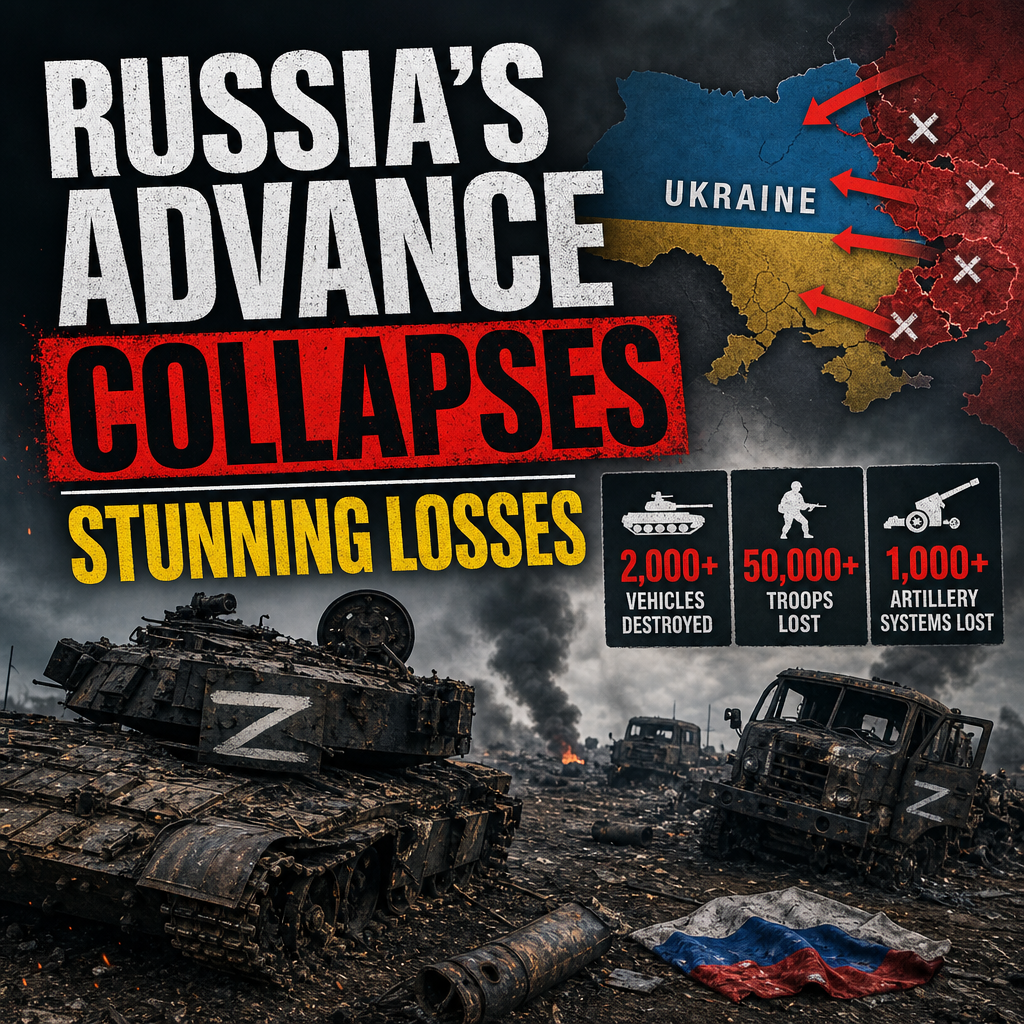
Russia’s Advance Collapses in Ukraine: Stunning Losses


Russia’s advance collapses in Ukraine has become a striking way to describe a battlefield shift that, if confirmed by multiple independent reports, would mark one of the war’s sharpest reversals in months. What stands out is not just the military setback itself, but the gap between how different outlets frame it: some emphasize Russian losses and rising unease in Moscow, while Russian state-aligned coverage tends to stress resilience, battlefield adaptation, and the idea that setbacks are temporary.
Russia’s advance collapses in Ukraine: what the reporting suggests
Across the coverage, a common theme emerges: Russia appears to be paying a high price for incremental gains, and in some sectors those gains may be stalling altogether. Reports describing “stunning losses” point to a familiar pattern in the war—heavy artillery use, drone warfare, and grinding infantry assaults producing casualties that are difficult to verify in real time but clearly significant enough to affect momentum.



The more cautious interpretation is that this is less a single collapse than a combination of local failures. Russian units may have been overextended, Ukrainian defenses more coordinated, and the cost of pushing forward higher than Moscow expected. In practical terms, that can mean advances slowing to a crawl, supply lines becoming vulnerable, and commanders being forced to pause offensive operations.
At the same time, it is important to separate battlefield imagery from strategic certainty. Wars often produce dramatic swings in narrative before the front line actually changes in a lasting way. A force can lose ground, suffer severe casualties, and still retain the ability to regroup. That is why the most responsible reading is not that Russia’s military machine has suddenly broken, but that it may be encountering a serious operational limit.




Why the losses matter beyond the front line
The significance of these setbacks extends well beyond the battlefield. If Russian forces are indeed absorbing unusually high losses for limited territorial gain, the consequences will be felt in several ways:
– Manpower strain: Sustaining offensive pressure becomes harder when experienced troops and equipment are depleted.
– Political pressure inside Russia: A long war with rising casualties can sharpen public anxiety, especially if gains are not obvious.
– Ukrainian morale: Even temporary reverses for Russian forces can strengthen Ukraine’s argument that continued resistance can work.
– Diplomatic calculations: Battlefield momentum often affects the confidence of allies, the messaging of adversaries, and the timing of negotiations.
This is where the reporting from different media ecosystems becomes especially revealing. Outlets that focus on the human and strategic cost of the war emphasize exhaustion, uncertainty, and the possibility that Russia’s war effort is reaching a difficult phase. Russian state-friendly coverage, by contrast, often presents setbacks as manageable and insists that military objectives remain intact.
Diverging narratives from Al Jazeera, RT, and Sky News
The contrast between the sources is less about whether the war is intense and more about how to interpret intensity.
Al Jazeera’s reporting tends to place the battlefield developments in a broader political context, linking military pressure to anxiety in Moscow and the wider costs of a drawn-out war. That framing encourages readers to see the fighting not as isolated combat reports, but as part of a larger story about sustainability: can Russia keep absorbing losses while preserving domestic stability and strategic initiative?
Sky News, drawing on the perspective common in British and European coverage, typically emphasizes the operational and human consequences of the war, often with a sharper focus on the toll Russian forces are taking and the implications for Ukraine’s defense. This style of reporting usually highlights that even if territorial lines move slowly, attrition itself can be decisive.
RT, on the other hand, is likely to frame any apparent setback in a way that protects the broader narrative of Russian endurance. In that view, temporary losses are not evidence of collapse but of a demanding campaign in which Russia still retains the resources and resolve to continue. That does not mean the facts are wholly denied; rather, they are contextualized so that battlefield difficulties appear less politically dangerous and less strategically final.
Taken together, these viewpoints suggest a crucial truth about the war: information is part of the conflict. Each side, and each media environment surrounding it, tries to define what success and failure look like before the final outcomes are known.
What can be said with confidence?
A fair assessment must stay grounded in what can actually be supported. Based on the reporting, several conclusions are reasonable:
1. Russia is facing serious battlefield pressure.
Even if the exact scale is disputed, multiple outlets indicate meaningful losses and setbacks.
2. The story is not just military, but political.
Reports of anxiety in Moscow matter because prolonged war fatigue can influence decision-making at the top.
3. The information environment remains contested.
Russian, Western, and regional outlets often describe the same situation in sharply different terms.
4. The final meaning of these losses is still uncertain.
Tactical reversals do not automatically translate into strategic defeat.
That uncertainty should not obscure the broader picture. If Russian forces are repeatedly failing to convert heavy assaults into durable gains, then the war may be entering a more difficult phase for the Kremlin than official messaging admits. But if history offers any guidance, it is that both sides will continue to claim momentum while the front line changes slowly.
The most balanced conclusion is this: Russia may not be collapsing in a total sense, but the reports point to a real and costly strain on its offensive capability. In a war of attrition, that kind of strain can matter as much as a dramatic breakthrough.

























